Sunday, November 18, 2012


Hans Roy, a geomicrobiologist from Aarhus University in Denmark and his team hauled a chunk of red colored mud from the bottom of the Pacific Ocean. He did not expect any surprises but he got one. Hans and his team embarked upon a month and a half long journey to only study the chemistry of the seafloor. The goal was to determine how much oxygen it absorbs from the water up above. Roy realized that some of the expected oxygen was missing after comparing the predicted levels of oxygen to the new measurements they had pulled up. Roy and his team believe that a hidden population of microbes was living in the mud, breathing in the oxygen. This is a prime example of why we should always expect the unexpected. Life can exist even in the most unexpected. Down at the depths of the seafloor, there are hidden, ancient organisms, just barely alive.
 
 
Information obtained at www.discovermagazine.com and pictures obtained at www.discovermagazine.com and www.scientificamerican.com

Friday, November 16, 2012


When people hear about E.Coli poisoning, many automatically think of it as caused from eating beef. The outbreak traced back to raw spinach is a reminder that the dreadful bacteria can spread through the droppings of animals to the produce growers’ soil, fertilizer, and water. The Microbiologists, Andrew Brabban and Betty Kutter’s goal is to destroy the disgusting bug in the intestines of the livestock; the prime source of the problem. They plan on doing this by using a virus that is a natural enemy of E.Coli. While students were studying E.Coli in sheep at the USDA Food and Feed safety research Unit, researchers at Washington’s Evergreen State College discovered the enemy virus. “Everytime they tried to infect the sheep with E.Coli, the sheep seemed to be within two days perfectly happy and they couldn’t find the bacteria,” says Brabban. “They had some natural resistance.” This is an interesting discovery.

Tuesday, November 13, 2012


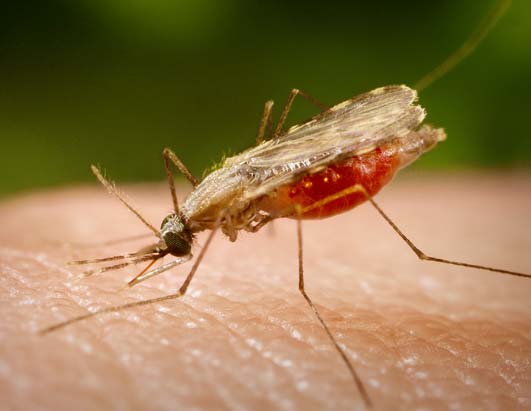
A new weapon against malaria comes from an unexpected place. It actually comes from the guts of a mosquito. George Dimopoulos, a microbiologist from John Hopkins University discovered a class of Enterobacter bacteria that lives inside of certain Zambian mosquitoes. It causes the insect to be resistant to Plasmodium falciparum, which is a parasite that causes malaria. The two microbes were placed into a petri dish. When they squared off, the Plasmodium was prevented from growing. When mosquitos sucked up the parasite along with the bacteria, the disease was not transmitted. Dimopoulos found out that the bacteria prevented the development of Plasmodium by unleashing a torrent of unstable oxygen molecules. Dimopoulos believes that those molecules are either chemical weapons that are normally used against rival bacteria or natural waste products. “The idea is to feed mosquitos in the field with an artificial nectar supplemented with bacterium,” says Dimopoulos. “It would be like a probiotic for the mosquito.” Mosquitos only have to ingest a tiny amount of the Enterobacter bacteria and they will be resistant to malaria. It is possible that the probiotic could be deployed in mass and can be strategically used throughout the tropical world. This can help to stop the mosquitos from spreading the disease to the approximate 250 million people that usually contract the disease ever year.
Information obtained at www.discovermagazine.com Pictures obtained at www.bimcbali.com and www.clarosci.com

Wednesday, November 7, 2012


Don Winget, the astronomer studies stars. His targets however are only about a yard away from him. Winget and his colleagues, for the past two have been creating plasmas that are miniature versions of white dwarf stars at the University of Texas at Austin and Sandia National Laboratory in Albuquerque, New Mexico. White dwarfs are ancient stars that have burned up all of their nuclear fuel. As Winget says, “Astronomy has now become an experimental science.” Once like our sun, white dwarfs are slowly dying embers of stars. These stars collapse into Earth-sized balls that are bound tightly to oxygen and carbon nuclei with an outer layer of hydrogen plasma due to no nuclear fusion to sustain them. Astronomers have a lot to learn about the stars’ plasma exterior, due to the fact that it is the only part directly visible through a telescope. Astronomers also have a lot to learn about these white dwarf stars in general.
 
 
Information obtained at www.discovermagazine.com pictures obtained at www.voanews.com and www.celestiamotherlode.net